The laundry that stopped charging by the kilo
October 10, 2026
My MBA final project: a laundry that loses linen and charges by the kilo, the tech that turns it into its hotels' partner, and the numbers behind it.
An industrial laundry with more than thirty years in the trade serves over forty hotels within 300 kilometers, on state of the art machinery. Every month it loses sheets and towels nobody can account for.
That was the case for our final project in the Master's in Business Administration, which I did with María Eugenia Daza. We defended it this week and got 9 out of 10, but before I get to how it went I want to walk through the case: it's useful to anyone working between technology and business.
Out of respect for the company I'm not naming it. The numbers are real, they come from its annual accounts.
Automated, and flying blind
The plant had modern industrial washers, dryers and ironers, and the information lived on paper. Garments were counted by hand, the inventory never matched and hotels had nowhere to look anything up.
Billing was the same as always: by the kilo. When you charge by the kilo, clients compare you on price alone and any cheaper competitor can take the contract.
We put it in one line: high maturity on the plant floor, low maturity in the data. Local competitors were worse off, and the big linen rental companies already tracked every garment and sold reports to their clients. Staying in the middle meant having no defense.
Two paths, and we picked the expensive one
Each of us designed an option. María proposed a collaborative platform, a portal where hotels request services, report issues and even swap surplus linen with each other.
I proposed tagging every garment with a radio frequency (RFID) tag, sending that data to the cloud and using AI to anticipate wear and demand. María's option cost €15,000 to €20,000. Mine cost €135,000.
| Option | Cost | Risk | Verdict |
|---|---|---|---|
| Collaborative B2B platform | Cost€15,000 to €20,000 | RiskHigh: swapping linen between hotels is a sanitary risk, and it's easy to copy | VerdictDropped as the core: it doesn't touch the cause of the losses and barely adds revenue |
| RFID traceability with cloud and AI | Cost€135,000 | RiskMedium: high upfront cost, and it depends on hotels adopting the platform | VerdictChosen: it goes after the cause, adds recurring revenue and is hard to copy |
We picked the expensive one because it was the only one that touched the cause of the problem. The other one didn't go in the bin: María's portal became the door hotels use to see their data, and her training plan is what carries the change for the people on the floor.
If you're starting out, here's the first lesson: a cheap fix that doesn't touch the cause is an expense, and an expensive one that does can be the best investment on the table.
The path of a towel
The solution has three layers, and the easiest way to follow it is to track one towel from the laundry to the hotel's report.
Every garment has a passive tag sewn in, no battery, a unique ID, built to survive more than 200 industrial washes.
The loading docks have reader arches: a cart with more than 500 pieces rolls through and in two or three seconds every one of them is logged, without unloading or counting anything.
The data travels encrypted to a cloud platform that only charges for what's used. There, machine learning models predict when a garment is about to wear out and how much linen each hotel will need in high season.
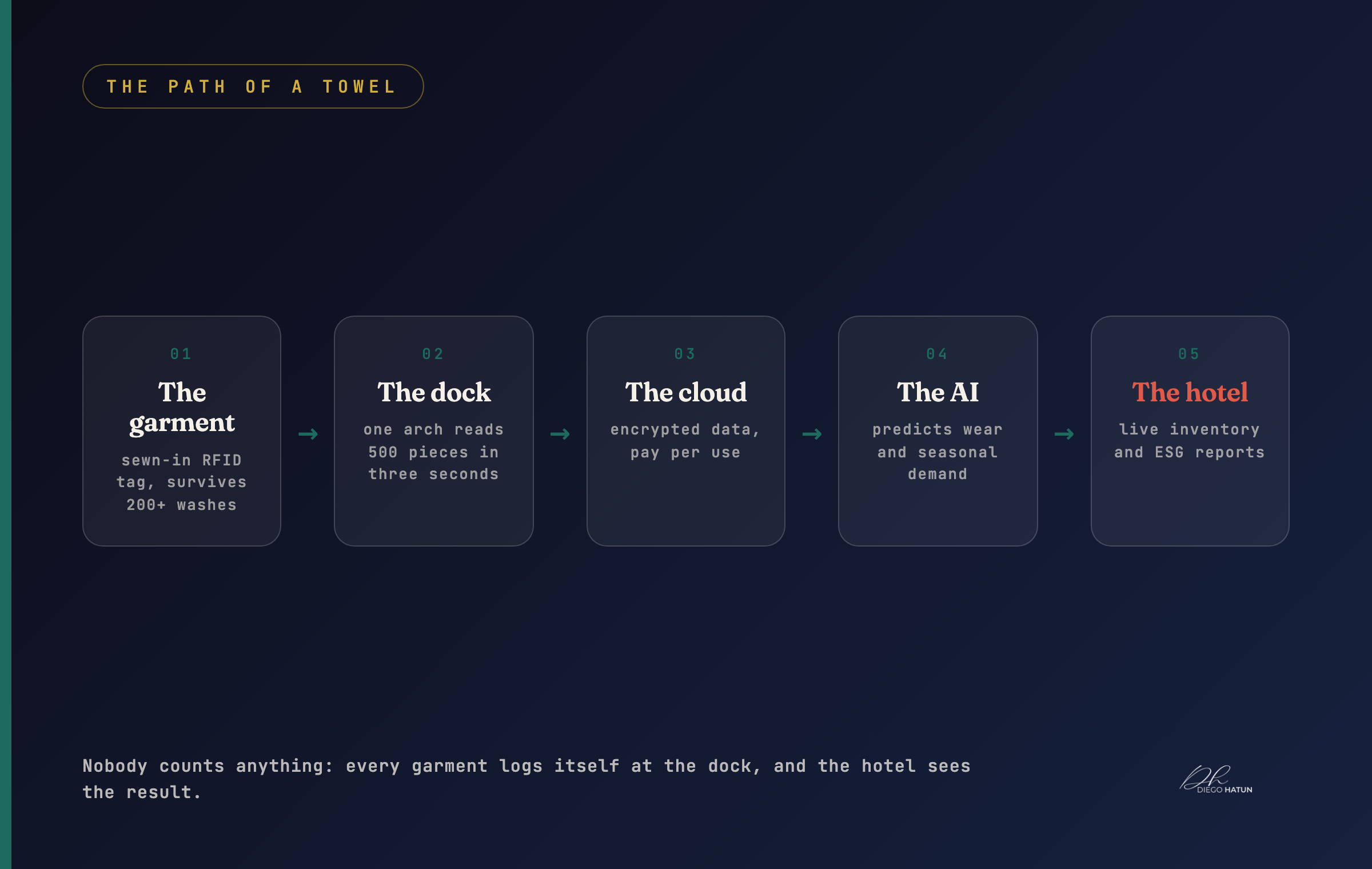
The same system produces the sustainability reports hotels already demand from their suppliers, the ones somebody builds by hand today, or doesn't build at all.
To get the idea off paper I built a simulator that emulates the arch readings and updates the hotel and laundry dashboards in real time. It isn't the product yet, but it answers the first thing any operations director asks: can I actually see this?
From the kilo to the subscription
Tags and cloud are the means. The real change is in what the laundry can start charging for.
The first stream is smart linen rental, a fee per managed garment with the hardware included and multi year contracts. The second is a subscription to the platform, where the hotel sees its inventory live, gets predictions and downloads its sustainability certificates.
For the laundry, that's recurring revenue that doesn't hang on the price per kilo. For the hotel, it's a tool they use every day, which is exactly why it's hard to walk away from: the laundry goes from a supplier compared on price to a technology partner.
The numbers, and the mistake we caught
An MBA won't let you fall in love with an idea before you run it through the calculator. The model covers three years, before taxes.
The upfront investment is €135,000: €45,000 for the platform, €25,000 for arches and readers and €65,000 for tags.
The return comes from two places. One is €38,400 a year that stops disappearing as lost linen, 20% of the €192,019 supplies spend, in line with the 15 to 20% the hotel RFID industry reports. The other is a subscription growing from €30,000 to €50,000 and then €70,000, minus about €22,000 a year to run the cloud.
27meses
That's how long a €135,000 investment takes to pay back, on hardware that lasts five to seven years.
At an 8% discount rate, net present value comes out at €32,255, the internal rate of return at 19.5% and the simple three year return at 46%.
Here's what taught me the most. The document we submitted said the IRR was 20.85%, and while preparing the defense I redid the math line by line: with those cash flows, at 20.85% the net present value goes negative. The right rate was 19.5%.
It didn't change the conclusion, and we still walked into the defense with the corrected calculation checked in an appendix. A small mistake you catch yourself is rigor. The same mistake caught by the committee puts everything else in doubt.
The question about the economy
The committee asked us about the global economy and how it would hit the project. Fair question, because this business lives off tourism: if hotel occupancy drops, volume drops, and a subscription is one of the first things a hotel cuts.
If money gets more expensive, so does the return the project has to clear. That's why the sensitivity matters more than the net present value: the project stays viable at any discount rate below 19.5%, with 13.5% savings instead of 20%, or if hotels pay only 75% of the projected subscriptions.
To avoid betting the full €135,000 at once, the proposal starts with a pilot in a handful of hotels. First you find out whether they really pay, then you commit the bulk of the money.
How we prepared
We got 9 out of 10, and the committee called out the presentation, the synthesis and the time management: we had 25 minutes and used exactly 25.
That came from rehearsing. María and I ran the full presentation three times, recorded ourselves, listened back and fixed what was off, and we studied far more than fit on the slides, thinking about what they might ask.
We split the talk: she took the context, the diagnosis and the choice of solution, I took the technology, the business model and the numbers. Whenever one of us hesitated, the other was there.
I'm taking away three lessons, and they work the same for an executive, an engineer or someone in their first job.
One: technology earns its place through the business model it unlocks. The tags and the cloud cost €135,000, and what changed the company was no longer charging by the kilo.
Two: defend a number with its range. “€32,255” convinces less than “it still works if hotels pay 25% less”.
Three: twenty five minutes on the dot isn't luck, it's three rehearsals, one uncomfortable recording and someone next to you who tells you the truth.
Thanks to María for the teamwork, and to Paola Villasmil for supervising the project.
Is your company still charging by the kilo, or is it already selling something clients won't want to give up?